

History of St. Al’s

School Motto
“Ad Deum Delectum Juventutis Meae”
[For God the Delight of my Youth]
The school motto appears on the school crest and the school crest is displayed prominently in the main entrance area of the school. The school crest colours are also mirrored in the school uniform. See below for a detailed description of the crest.
Historic Cork School, St. Aloysius’ School Celebrate Landmark Anniversary
As the first secondary school to open its doors to girls in Cork celebrates a milestone anniversary, former pupils and staff members are invited back to take a look through its 180-year history. (2019)
To mark the anniversary of its founding, St. Aloysius School in Cork City is preparing to open its doors on Saturday, November 16th, to welcome back past-students and staff members who may want to take a stroll down memory lane.
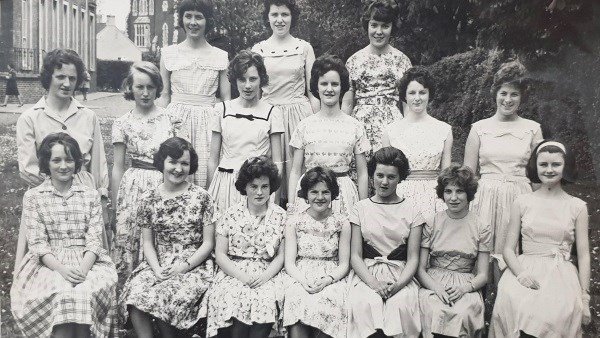
Students pictured in the school gardens in 1961
Among the distinguished past pupils of the school are Rena Buckley, one of the sportspeople in the country’s history; Dr. Miriam J. Smyth, a deputy director at the US Department of Veteran Affairs; and Karina Buckley, RTÉ weather presenter and founder member of ‘Climate Without Borders’.
In preparation for the anniversary, St. Aloysius teachers Miriam Uí Dhonnabháin, Patrick Foran and Amber Walsh have been examining the school’s history and archives.
St. Aloysius’ roots begin in 1839, when the Sisters of Mercy started their pension school out of a room in their convent on Rutland Street. This was at the suggestion of Mother Catherine McAuley.
At the same time, the Sisters also taught in parish schools in Carey’s Lane and in Blarney Lane, according to Ms. Uí Dhonnabháin, a former past-pupil who teaches Irish, English and heritage at the school today.
We’re very fortunate in that we had here for many years on staff, and in the convent, Sister Angela Bolster, who is also known by her own name, Evelyn Bolster. “She was a very eminent historian, she wrote the history of the Diocese of Cork and Ross and she did an awful lot of research on the life of Catherine McAuley and the work of the Sisters of Mercy.” When Catherine and her Sisters arrived, it was within a very short period of the cholera epidemic in Cork, and they had a dreadful journey. They came (to Cork) by ship from Dublin and a couple of them were really ill on the journey. They took one day to recover and the following day, they were visiting the poor. They got the names of people they ought to visit from the Presentation Sisters. So they were really hands-on and incredibly hardworking.
Within six years, the Great Famine arrived in Cork. “A number of the Sisters who arrived with Catherine died within the first 10 years, and certainly more of them died ministering to the poor during the famine,” Ms. Uí Dhonnabháin added.
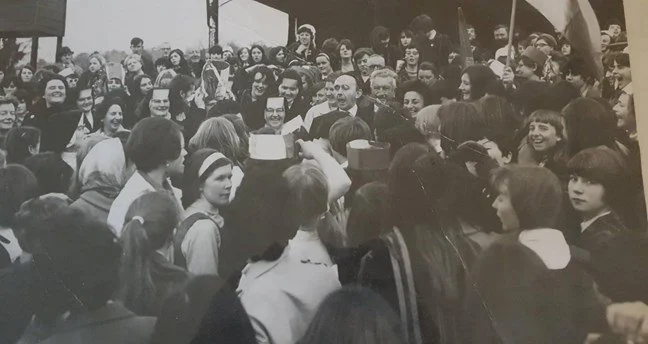
Celebrating a St. Aloysuis camogie win. Pictured in the centre is Sister Columba, who was the Principal of the school from 1963 to 1979
It would have been easy (for the Sisters) to cut and run because these girls generally speaking came, generally speaking, from comfortable backgrounds themselves. They chose to do what they were doing.
While the Presentation Sisters ran a primary school on Douglas Street at the time, there wouldn’t have been the option of any kind of secondary education for the young women of Cork city. “It was very forward-looking,” she said, adding that St. Aloysius was also set up in a very poor area.
Students at the time would have studied Irish, English, Latin, French, arithmetic, science, history, geography and book-keeping with art, with music, elocution and PE offered as extras. Catherine was a great believer in practical subjects for women, things that would enable them to earn a living.
St. Aloysius was also the first girls’ school in Ireland to offer physics for the Leaving Cert, which it introduced in the 1930’s.
“It was fairly significant. Sister Mercedes Desmond in the convent, who was our Principal here for many years, and prior to that a chemistry teacher, was recognized for her work in the field of science, for women, and in University College Cork (UCC), and also by the Science Teachers Association of Ireland.”
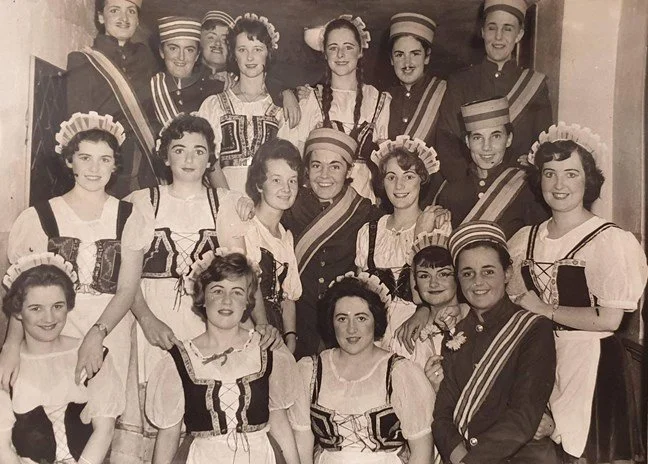
A school production of ‘The Student Prince’ in 1963
The school also has an impressive sporting history, according to Patrick Foran, who teaches history and geography at the school. “In 1969, the school made it to the first-ever All-Ireland school’s final in camogie, and took home the title in 1976.” In 1927, St. Als moved to a two-storey building on its present site. Following a major build in 1970, the school expanded to include, among other facilities, a purpose built library.
This year, the school received the PDST Wellread National Award following a two-year campaign started by teachers Amber Walsh and Amanda Gaine to promote a culture of reading within the school community.
The school will open its doors between 10.30am and 3.30pm on Saturday. During the course of the day, the school choir is due to perform. Two heritage and history talks are also due to take place, one at 11 am and the other at 2pm.
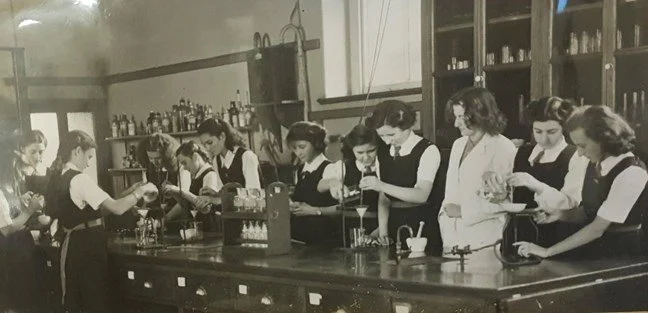
Class in the old science room at St. Aloysuis in 1947
“We’re also going to have a display of St. Aloysius through the decades along the corridors of the school,” Patrick Foran said. “We will have photographs from each decade so past pupils can see if they can find themselves. We’ve lots of lovely old photographs, going way back into the 1930s even.”
Students have also put together a timeline charting both the history of the school as well as the major events that were happening at the time, according to Amber Walsh.
“When you think about how long the school is here, the history of St. Als really is the history of Cork city. Cork has always been a forward-looking city, and county.”
This article was first published in the Irish Examiner and was written by Jess Casey
History of St. Al’s
St. Aloysius School began in a large room in a house in Rutland Street in 1839 at the suggestion of Mother Catherine McAuley, foundress of the Sisters of Mercy. Here in this house the sisters lived and taught for thirteen years.
In 1852 the sisters moved to their present location of St. Maries of the Isle and in two big rooms in the Convent continued to teach girls and boys who came every day for lessons. A hedged-off portion of the convent garden was used as a school playground.
In 1893 the school relocated across the road in the buildings which became affectionately known by generations of Aloysians as ‘The Old School’. This ‘Old School’, demolished in 1978 for safety reasons, occupied the grass area inside the school gate.
In this ‘Old School’ generations of Aloysians were educated and in 1924 the ‘Railway Field’ was purchased. This gave room for expansion and so in 1927 the then big school buildings which gained the name ‘The New School’ were opened, while the rest of the Railway Field became the playing fields and tennis courts.
Later in 1962 the New Wing was added and in 1972 an upper storey and additional blocks which housed new classrooms, laboratories, special subject rooms, a library, a gym hall and a general purposes room (now the canteen). Since then, school facilities including the Computer Room, Music Room, Science Laboratories and Home Economics Rooms keep up with modern changes in technology.
The whole complex of bright airy rooms over-looking a pleasant, tree-lined field beside the River Lee, is very different from the large room in Rutland Street where it began but the same dedication and loyalty are still to be found here more than a century later. In 2019 the school proudly celebrated its 180th. anniversary of involvement in education.
Symbolism of our School Crest
The School Crest is divided into four quadrants.
The first quadrant shows a crown surmounted by a cross. St. Aloysius Gonzaga was the oldest son of the Marquis of Castiglione and a prince of the Holy Roman Empire. In his teens he ceded his rights and his title to his brother and entered the novitiate of the Jesuits. The crown in this quadrant symbolises the material goods which St. Aloysius willed away to give himself utterly to God. The Cross with the Mercy Scroll is part of the insignia of the Sisters of Mercy. So this small picture stands for both the name of the school and for the congregation of Sisters who conduct the school.
The second quadrant shows a river with a bridge and behind the bridge stands a Church spire. It is believed that St. Finbarr lived most of his life in the area between Gillabbey Rock and the site which now holds St. Finbarre’s Cathedral. This very area on which so many Aloysians now walk has been sanctified by the feet of St. Finbarr in his youth and his age.
The third quadrant shows the torch of knowledge which is the international school emblem and it reminds us that to each of us that torch is handed- alight- and we must pass it on and keep it alight, as St. Aloysius School has done for over a hundred and sixty years.
In the fourth quadrant we see the school colours which have a striking symbolic connection with the religion that is ours. Grey traditionally represents the symbol of Faith. Green is the symbol of Hope. Red has always been used to represent the symbol of Charity.